Dissolution of a Registered Partnership

Attorney specializing in family law & divorces, founder of the law firm IBESICH
Legal Notice/Disclaimer: The following information is intended for general guidance only and does not replace individual legal advice. For advice tailored to your specific situation, please consult a lawyer or another qualified legal professional.
The dissolution of a registered partnership is a significant step in a couple’s life. Anyone in Austria who is facing the termination of a registered partnership should be aware of their rights and available options.
On this page, you will find a comprehensive overview of all key aspects – from filing the application and the distinction between consensual and contested proceedings to matters of maintenance, division of assets, and child custody arrangements. The information provided is up to date and professionally reviewed, enabling you to plan your next steps on a well-informed basis. Please note that statutory provisions may change.
What you need to know
- Marriage vs. Registered Partnership
- Largely equivalent, mostly differing only in terminology
- Largely equivalent, mostly differing only in terminology
- Consensual dissolution:
- Both partners are in agreement
- Agreement on all legal consequences is required
- Joint application to the district court
- The partnership-based living arrangement must have ceased for at least six months
- The registered partnership must have existed for at least six months
- Contested dissolution:
- No agreement between the partners
- Court action filed by one partner
- Serious misconduct or irretrievable breakdown after at least three years of separation
- Six-month limitation period from the time the ground for dissolution becomes known
- Maintenance after dissolution:
- Maintenance may be granted where one partner bears predominant fault
- Maintenance may be granted where one partner bears predominant fault
- Division of assets:
- Division of household assets and savings
- By agreement of the partners or by court decision
- Exclusion of pre-existing assets, inheritances, and gifts
- Children & custody:
- Joint custody generally remains in place
- An agreement on care and residence arrangements is required
- Primary residence usually with one parent
- The non-caring parent is obliged to provide financial support
Table of Contents
Introduction: What is a registered partnership?
A registered partnership in Austria is a legally recognised long-term relationship. It was originally created for same-sex couples. Since 1 January 2019, however, both same-sex and opposite-sex couples have been able to choose whether to enter into a marriage or establish a registered partnership. In practice, this means that a registered partnership today gives rise to largely the same rights and obligations as a marriage – particularly with regard to maintenance, child custody, and inheritance law. It therefore represents an alternative to marriage, while retaining its own distinct legal framework.
The legal definition of a registered partnership is set out in the Registered Partnership Act (Eingetragene-Partnerschaft-Gesetz, EPG). It defines the partnership as a life partnership with mutual rights and obligations. Registered partners are obliged to provide mutual support, show respect, and organise their lives together. In everyday terms, this means, for example, that both partners must contribute to the joint household and living expenses – either financially or through managing the household. At the same time, registered partners generally retain their previous surnames, but they may choose a common family name or adopt double-barrelled surnames.
Who is a registered partnership intended for? Originally, it was introduced – prior to the opening of marriage – for same-sex couples in order to provide legal protection similar to marriage. Since legal equality was established in 2019, it has been open to all couples, regardless of gender. Some couples consciously choose a registered partnership for personal or symbolic reasons, even though they could also marry. Others no longer make use of this option, as the distinction has lost significance following the introduction of “marriage for all”. Nevertheless, the registered partnership remains anchored in Austrian law and continues to be relevant – particularly for couples who entered into such a partnership in the past and are now seeking to separate.
The current relevance of the registered partnership therefore lies primarily in the need to dissolve existing partnerships. Even though new partnerships are now established less frequently, many people in Austria still hold this legal status. Clear rules apply to them as to how a registered partnership can be lawfully terminated.
Registered Partnership vs. Marriage – the key differences
In many respects, marriage and registered partnerships are now legally equivalent. However, there are still some differences in specific details and in terms of social perception. Below is an overview of the most important distinctions:
- Formation & formal requirements: A marriage is concluded through a civil ceremony before a registrar, whereas a registered partnership is established by registration before a registrar or the district administrative authority. Since 2019, the procedures have become very similar, as mixed-sex couples can now also enter into a registered partnership. The remaining differences are mainly formal in nature – for example, during a marriage ceremony the traditional exchange of vows (“I do”) takes place, while a registered partnership is formed through a joint declaration. In both cases, the presence of both partners and witnesses is required, and both are recorded in the civil status register.
- Name law: In a marriage, the spouses may choose a common family name or retain their respective surnames. The same largely applies to registered partnerships: as a rule, each partner keeps their own name, but a common family name or a double-barrelled name may be chosen. Historically, one difference was that registered partnerships did not provide for an automatic “family name”. Today, however, registered partners may carry a common surname in the same way as married couples. Important to note: after dissolution of the partnership, a partner who adopted the other partner’s name may revert to their former name, but this does not happen automatically and must be declared to the relevant authority.
- Property regime: Both marriage and registered partnership are governed by separation of property. This means that each partner remains the owner of the assets they bring into the relationship. There is no automatic joint property. Upon dissolution – whether through divorce or dissolution of a registered partnership – jointly used household assets and savings are divided according to statutory rules. This includes jointly acquired or jointly used items (such as an apartment, household goods, or a car) and savings accumulated during the relationship. Personal items and assets acquired by inheritance or gift remain excluded. Overall, the rules governing asset division upon divorce and upon dissolution of a registered partnership are almost identical.
- Grounds for dissolution & procedure: The ways in which a relationship may be legally ended are comparable. A marriage may be dissolved by consensual divorce or by contested divorce; a registered partnership may likewise be dissolved either consensually or through contested court proceedings. The recognised grounds for dissolution are essentially the same – for example, serious fault of one partner (such as violence), long-term breakdown of the relationship, or mental illness. Further details are explained in the following section. One minor formal distinction remains: in the case of marriage, the term “divorce” is used, whereas for registered partnerships the term “dissolution” applies. In both cases, however, the decision is made by court order. The competent courts are the same (district courts), and the procedural steps are largely identical.
- Maintenance during and after the relationship: During an existing marriage, there is a mutual obligation of maintenance, based on the spouses’ standard of living. The same applies to registered partnerships. After a divorce, post-marital maintenance may be granted depending on fault and financial need. Similarly, following the dissolution of a registered partnership, post-partnership maintenance may be awarded if the statutory requirements are met. In both cases, there is no automatic entitlement to maintenance. However, the partner who is predominantly at fault must provide appropriate support to the other partner if they are unable to support themselves. In cases of shared fault, maintenance based on equity may be granted. These rules are regulated in almost identical terms under the Marriage Act and the Registered Partnership Act (EPG).
- Parenthood & adoption: For a long time, registered partners were not permitted to jointly adopt children. This has since changed. Registered partners have been allowed to adopt for several years now. Same-sex couples may either jointly adopt a child or adopt the biological child of their partner through stepchild adoption. As a result, registered partners are now largely equal to married couples in matters of parenthood. Both partners may be legal parents of a child and, in the event of separation, are subject to the same custody and maintenance obligations as divorced spouses.
- Inheritance law: Under statutory inheritance law, registered partners are treated in the same way as spouses. If one partner dies, the surviving partner inherits a statutory share (alongside any children of the deceased) and is entitled to a compulsory portion, just like a widowed spouse. This inheritance right ceases, however, if the partnership has already been dissolved. Once dissolution becomes legally effective, no inheritance rights remain – former registered partners are then regarded as legal strangers. During an existing partnership, however, partners enjoy full protection under inheritance and compulsory portion law, equivalent to that of married couples. Accordingly, in the event of separation, it should be noted that upon completion of the dissolution proceedings, any testamentary benefits granted to the former partner may lapse.
- Symbolism & public perception: Beyond legal considerations, there are also differences in perception. Marriage is traditionally regarded as the “classic” union, often associated with a church ceremony and social rituals. Registered partnerships are more formal in nature – there is no religious ceremony, and they were originally introduced as a separate legal institution for same-sex couples. Some same-sex couples consciously maintain their registered partnership, while others wish to convert it into a marriage (which is currently only possible by dissolving the partnership and subsequently marrying). Overall, however, registered partnerships are no longer viewed as a “second-class marriage”, as the legal rights have been largely aligned. Anyone separating from a registered partnership can therefore expect that rules similar to those applicable to divorce will apply – as explained in detail in the following sections.
Requirements for the dissolution of a registered partnership
The dissolution of a registered partnership may take place either by mutual consent or through court proceedings (contested). Different legal requirements apply depending on the chosen option. Below is an overview:
- Consensual dissolution: Both partners agree to end the partnership. A key requirement is that the partnership-based living arrangement has been terminated for at least six months, meaning that the partners have not lived together in a marriage-like relationship for a minimum of half a year. In addition, both must declare that the relationship is irretrievably broken, i.e. that reconciliation can no longer be expected.
It is also essential that the partners reach agreement on the legal consequences of the dissolution. For a consensual dissolution, the law requires an agreement on maintenance (if one partner is to provide support) and on all property-related matters. In practice, this means that the partners must, for example, agree on the division of assets and any debts, and clarify whether post-partnership maintenance is to be paid. This agreement – often referred to as a “dissolution agreement” – is submitted to the court. Once all these requirements are met, the partners may jointly file an application for dissolution of the registered partnership with the competent district court. - Judicial (contested) dissolution: If only one partner wishes to separate, or if there is disagreement regarding fault or the legal consequences, the registered partnership must be dissolved by the court. In such cases, one partner files an action for dissolution with the district court. This step requires a legally recognised ground for dissolution (similar to grounds for divorce). The court then decides, in civil proceedings, whether the partnership is to be dissolved.
Important: Unlike consensual dissolution, there is no requirement that the partners must have lived separately for six months. Court proceedings may be initiated earlier, provided that a recognised ground for dissolution exists. - Recognised grounds for dissolution: Not every disagreement is sufficient to justify a contested dissolution. The law explicitly lists certain grounds under which a registered partnership may be dissolved:
- Serious fault of one partner: If one partner’s misconduct has so profoundly damaged the relationship that its essential purpose can no longer be fulfilled, this may justify dissolution. Typical examples include physical violence, severe emotional abuse, but also infidelity or persistent refusal to maintain a shared life.
Important: An action based on fault must be filed within six months from the time the misconduct becomes known. If the misconduct has been forgiven, this ground can no longer be invoked. - Mental illness or comparable circumstances: If a partner’s conduct, due to a mental disorder, leads to an irretrievable breakdown of the partnership, the other partner may also seek dissolution. The same applies if one partner suffers from a serious contagious or repugnant disease for which recovery or significant improvement is not foreseeable. These grounds correspond to the divorce grounds of “mental illness” and “contagious or repugnant disease” under the Marriage Act.
- Permanent termination of the shared household: If the partners’ domestic community has ceased to exist for three years, either partner may seek dissolution on the grounds of irretrievable breakdown. This so-called “three-year period” allows dissolution without attributing fault, comparable to divorce after three years of separation.
Other grounds, such as dissolution for the protection of a partner under guardianship, are rarely relevant in practice and constitute exceptional cases. In most contested dissolutions, the claim is therefore based either on fault (such as infidelity or violence) or on long-term separation.
- Serious fault of one partner: If one partner’s misconduct has so profoundly damaged the relationship that its essential purpose can no longer be fulfilled, this may justify dissolution. Typical examples include physical violence, severe emotional abuse, but also infidelity or persistent refusal to maintain a shared life.
Example: Martin and Stefan have been registered partners since 2014. In 2025, Martin falls in love with someone else and moves out of the shared apartment in March. Stefan wishes to end the partnership immediately, but Martin refuses because he wants to avoid the formal consequences (maintenance, division of assets). Stefan could now either file an action for dissolution based on fault, arguing that Martin has irretrievably broken the partnership. Since Martin moved out in March, Stefan would have to file the action by September at the latest (six months from the time he became aware of the misconduct). Alternatively, if Stefan prefers not to initiate proceedings immediately, he could wait until three years of separation have elapsed (i.e. from March 2028 onwards) and then seek dissolution on the grounds of irretrievable breakdown without a finding of fault. In the first case, the court would examine Martin’s fault; in the second case, the three-year separation alone would be sufficient as grounds for dissolution.

Procedure for dissolution – step by step
Once the decision to dissolve the partnership has been made, the next question concerns the specific procedure. Below is an overview of the individual steps and stages involved:
- Choosing the competent court: As with divorce proceedings, dissolution of a registered partnership falls within the jurisdiction of the district courts (Bezirksgerichte). Territorial jurisdiction lies with the district court in whose district the partners last had their common habitual residence.
Example: If the partners last lived together in Vienna 23, the Liesing District Court has jurisdiction. If they later lived separately in different locations, the court of the last shared residence remains competent. - Filing an application or action:
- Consensual dissolution: Both partners jointly file an application for dissolution of the registered partnership with the district court. The Ministry of Justice provides a specific form for this purpose, which must be completed and signed. The application may be submitted in writing or dictated orally on the court’s official office day. In the application, the partners must declare that the shared living arrangement has been terminated for at least six months and that the relationship is irretrievably broken. The agreement reached regarding maintenance and division of assets should be attached or outlined in the application. Once the application has been received, the court schedules a hearing at which both partners must appear in person. The court reviews whether all legal requirements are met and records and approves the agreement. The proceedings conclude with a court order dissolving the registered partnership.
- Contested dissolution: The partner seeking dissolution files a statement of claim with the district court. This must also be submitted in writing (or dictated into the record on an office day). The claim must set out the grounds for dissolution and the factual circumstances supporting them. After receipt, the court serves the claim on the other partner (the defendant). A hearing is then held, during which witnesses may be examined and evidence presented, for example to establish fault. The proceedings take the form of a civil lawsuit. At the end, the court delivers a judgment either dissolving the registered partnership or dismissing the claim. If dissolution is granted, the judgment may include a finding of fault (i.e. which partner was primarily responsible for the breakdown), which is relevant for maintenance claims. Important: the registered partnership continues to exist until the judgment becomes legally binding. An appeal may be lodged against the first-instance judgment, which prolongs the proceedings. If no appeal is filed, the judgment becomes final after 14 days.
- Consensual dissolution: Both partners jointly file an application for dissolution of the registered partnership with the district court. The Ministry of Justice provides a specific form for this purpose, which must be completed and signed. The application may be submitted in writing or dictated orally on the court’s official office day. In the application, the partners must declare that the shared living arrangement has been terminated for at least six months and that the relationship is irretrievably broken. The agreement reached regarding maintenance and division of assets should be attached or outlined in the application. Once the application has been received, the court schedules a hearing at which both partners must appear in person. The court reviews whether all legal requirements are met and records and approves the agreement. The proceedings conclude with a court order dissolving the registered partnership.
- Required documents:
To ensure that the proceedings run smoothly, several documents should be prepared in advance:- Partnership certificate: The official certificate confirming registration of the partnership (comparable to a marriage certificate), required to verify the existence and date of the partnership.
- Proof of last common residence: Registration certificates or similar documentation are useful, as the court must determine the last shared habitual residence.
- Identification documents: Official photo identification (passport or ID card) of both partners for identification purposes.
- Documents relating to children (if applicable): For example, birth certificates of joint children for custody and maintenance arrangements.
- Documents relating to assets: Such as land register extracts, lease agreements, bank statements, lists of savings, loans, or other assets and liabilities to be divided. These documents help formalise an agreement or provide the court with an overview.
- Settlement agreement (in consensual cases): If the partners have already recorded the consequences of dissolution (maintenance, division of assets, housing, debts, and, if applicable, children) in a written agreement, this document should be submitted. It can then be recorded by the court as a settlement.
- Partnership certificate: The official certificate confirming registration of the partnership (comparable to a marriage certificate), required to verify the existence and date of the partnership.
- Duration of the proceedings: The time required from filing the application or claim until the dissolution becomes legally binding varies considerably depending on the individual case.
- Consensual dissolution: As the partners have already reached agreement, proceedings are usually relatively swift. Often, only a few weeks to a few months pass between filing the application and the court hearing, depending on the court’s workload. At the hearing, the dissolution is often ordered immediately. Once the order becomes final (usually after 14 days if no appeal is lodged), the partnership is officially dissolved. Overall, a consensual dissolution can typically be completed within approximately two to three months, and in straightforward cases sometimes even faster.
- Contested dissolution: These proceedings generally take significantly longer. From filing the claim to receiving a first-instance judgment, several months to more than a year may pass, depending on the complexity of the case (for example, whether witnesses must be heard or expert opinions obtained) and the court’s schedule. If one partner lodges an appeal, the case proceeds to a higher instance, which may add many more months or even years. In total, contested proceedings may therefore last one to three years, or longer in exceptional cases. During this entire period, the registered partnership remains legally in force.
Tip: In some cases, it may be advisable to seek an amicable settlement even during ongoing proceedings, in order to shorten the duration and reduce costs.
- Consensual dissolution: As the partners have already reached agreement, proceedings are usually relatively swift. Often, only a few weeks to a few months pass between filing the application and the court hearing, depending on the court’s workload. At the hearing, the dissolution is often ordered immediately. Once the order becomes final (usually after 14 days if no appeal is lodged), the partnership is officially dissolved. Overall, a consensual dissolution can typically be completed within approximately two to three months, and in straightforward cases sometimes even faster.
Example (consensual): Sandra and Nina have been living separately for more than six months and wish to dissolve their registered partnership by mutual consent. They agree on a fair division of their household goods and that neither will claim maintenance from the other, as both are employed. Together, they complete the form “Application for consensual dissolution of a registered partnership” and submit it to the district court. Just five weeks later, they attend the hearing before the judge. There, both again confirm the irretrievable breakdown of the relationship, and their agreement is dictated into the court record. The judge issues the dissolution order. Once it becomes legally binding (14 days later), both receive written confirmation – the registered partnership is officially terminated.
Example (contested): Alex and Bernd have fallen out. Alex wishes to end the partnership, Bernd does not. Alex therefore files an action for dissolution on the grounds of irretrievable breakdown. Court proceedings follow, during which Alex explains that Bernd repeatedly subjected him to severe verbal abuse and financially exploited him. Bernd denies these allegations. The proceedings last eight months, including witness testimony from friends. Ultimately, the court decides to dissolve the partnership and finds Bernd to be predominantly at fault. Bernd does not file an appeal, and the judgment becomes legally binding after 14 days. In total, the proceedings took approximately ten months.

Rights & obligations during separation
Between the factual separation and the formal dissolution, several months often pass (or even longer if the proceedings are contested). During this transitional period, the partners are still legally bound by a registered partnership. This gives rise to certain rights and obligations that should be clearly understood:
- Use of the shared residence: Once the partners live separately, the question arises as to who may remain in the former shared home. If an agreement is reached, one partner may move out while the other remains in the apartment. Such an agreement should always be recorded in writing.
In the event of a dispute, the court may decide – either within the framework of the asset division proceedings or by way of an interim order – who is entitled to use the residence on a provisional basis.
Important: As long as the partnership exists, neither partner may simply exclude the other from the home. In principle, both partners have the right to use the former shared residence until a different agreement or court decision is in place. An exception applies in cases of domestic violence: if violence occurs, the police may immediately prohibit the violent partner from entering the home by issuing a restraining order (removal order). In addition, the court may grant an interim injunction to protect the endangered partner, such as a prohibition on entering the home or approaching the other partner. In practice, it is strongly advisable to reach clear arrangements regarding housing as early as possible – ideally by mutual agreement. If both partners are joint tenants or co-owners, the tenancy or ownership situation remains unchanged for the time being, until a final arrangement is made in the course of the dissolution proceedings (for example, one partner taking over the lease). - Financial responsibilities: Even during separation, the mutual obligation of maintenance within the partnership generally continues to apply. If one partner lives elsewhere, this may mean that the higher-earning partner must temporarily pay separation maintenance to cover the other partner’s living expenses. While Austrian law does not formally recognise a separate legal concept of “separation maintenance”, maintenance is typically payable in monetary form once the shared household has been discontinued.
In practical terms, if one partner has no independent income, they may already claim financial support from the other partner before the partnership is formally dissolved. If necessary, this can be enforced through the courts by filing a maintenance claim. At the same time, both partners remain responsible for ongoing financial obligations they entered into jointly – such as loans or rent (provided both are contractual parties). No one should assume that moving out releases them from all financial responsibilities. Only the final division of assets and debts determines who ultimately bears which obligations. Therefore, it is essential during separation to keep track of joint bills, account balances, and loan instalments to avoid unnecessary debt. - Protective measures in cases of violence: Unfortunately, domestic violence can also occur in registered partnerships, and the risk often increases during periods of separation. For this reason, clear protective mechanisms exist. If one partner threatens or commits violence against the other, the endangered person may immediately contact the police. The police are authorised to impose a ban on entering and approaching the residence (removal order), prohibiting the violent partner from entering the home or approaching the other person. This protection initially applies for two weeks and may be extended. In addition, an application may be filed with the district court for an interim injunction under the Domestic Violence Act, extending protection for several months. Compliance with these measures is strictly monitored. Parallel to this, dissolution proceedings may of course be initiated.
Example: After five years of a registered partnership, Claudia and Sonja separate. Claudia temporarily moves in with a friend. Both partners signed the lease agreement together. Claudia continues to pay half of the rent until it is clarified who will permanently take over the apartment. Sonja earns significantly more and, at Claudia’s request, pays her a monthly maintenance contribution until the partnership is dissolved, enabling Claudia to cover her living expenses. In this way, they bridge the separation period fairly without court proceedings.
In another case, Peter and Johannes separate amid conflict. Peter becomes aggressive and threatens Johannes, who calls the police. Peter is issued a ban from entering the apartment. Johannes additionally applies for an interim injunction prohibiting Peter from approaching him. This ensures Johannes’ protection for the remainder of the separation period, until the registered partnership is formally dissolved.
Division of assets upon dissolution
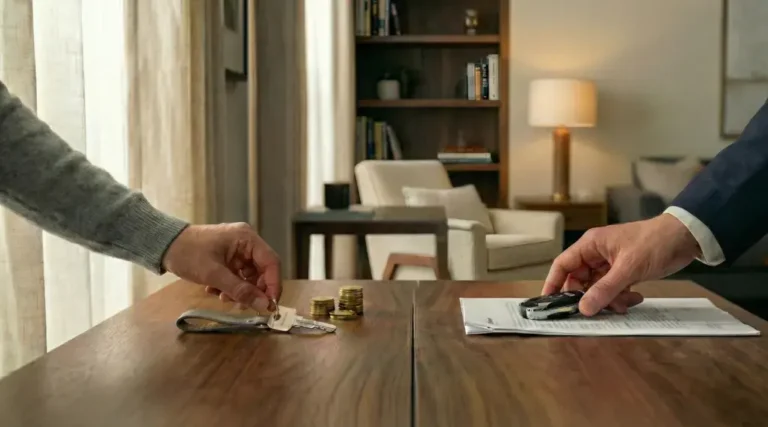
One of the central issues in the dissolution of a registered partnership is the division of jointly used assets and any existing debts. In this respect, the legal framework largely corresponds to that applicable to divorce:
- Principle: separation of property: During the partnership, each partner generally retains ownership of their own assets (bank accounts, real estate, vehicles, etc.) that they brought into the relationship or acquired independently. There is therefore no automatic pooling of assets. Accordingly, each partner is also liable only for their own debts. However, the principle of separation of property does not mean that everything remains strictly separate at the end of the relationship – assets that were used jointly or accumulated together are subject to division.
- Jointly acquired assets: All assets that the partners acquired or saved together during the partnership are divided upon dissolution. This includes in particular:
- Household and everyday assets: Items used jointly, such as furniture, household appliances, vehicles used by both partners, and similar property. Even if such items are formally owned by only one partner (for example, if the purchase contract is in one name only), they are taken into account in the division if they were acquired for the shared life.
- Savings: Funds accumulated during the partnership, such as joint bank balances, savings accounts, or investment portfolios, provided they were financed from ongoing income. These are commonly referred to as “partnership savings” and are likewise subject to division.
Certain assets are excluded from division, however: personal items (such as clothing, gifted jewellery, or personal mementos), items required for a partner’s profession, business interests owned by one partner, as well as gifts and inheritances received by one partner. These assets remain with the respective partner unless different arrangements have been contractually agreed. All other assets are subject to statutory division.
- Household and everyday assets: Items used jointly, such as furniture, household appliances, vehicles used by both partners, and similar property. Even if such items are formally owned by only one partner (for example, if the purchase contract is in one name only), they are taken into account in the division if they were acquired for the shared life.
- Debts & liabilities: Debts incurred by one partner alone generally remain that partner’s responsibility. There is no joint and several liability for a partner’s private debts within a registered partnership. However, joint debts – meaning liabilities connected to jointly used assets or savings – are taken into account in the division.
Example: If both partners jointly took out a loan to finance a car, this loan is included in the division and allocated proportionately. Partners often agree in advance on who will assume which debts. If no agreement is reached, the court decides based on principles of equity.
Important: No partner is liable for the personal debts of the other (for example, business debts), unless they have personally signed as a co-debtor. Nevertheless, such debts may become indirectly relevant – for instance, if debts incurred during the relationship reduce the amount of jointly accumulated savings available for division.
- Partnership home and household contents: The residence in which the partners last lived together (the partnership home) has a special status. If the apartment was jointly rented, the partners may agree on who will continue the lease. If the property belongs to one partner alone, it generally remains that partner’s asset – however, it may still be taken into account in the division under certain circumstances. This may be the case, for example, if one partner is particularly dependent on the residence after separation (such as where a joint child continues to live there) and excluding that partner would be inequitable.
In such cases, the court may order that the partner in need may continue to use the residence (or part of it), potentially subject to compensation. As a general rule, household items and the residence are allocated to the partner who needs them more urgently or primarily uses them, provided this is fair. The objective of the division is to separate the former partners’ living arrangements as much as possible going forward. The court may even transfer ownership of specific items – for example, awarding a vehicle to one partner – usually against payment of compensation. Many couples reach an agreement regarding household contents and the residence in advance in order to simplify court proceedings. Such agreements should be detailed (e.g. which furniture, who takes over the lease) to avoid later disputes.
Ideally, the partners agree on the division of assets themselves and record this agreement in writing (for example, as part of a consensual application in the form of a settlement). The court reviews such agreements and usually approves them, provided no gross disadvantage to either party is apparent. If the partners cannot agree, the court decides based on equity, taking into account the contributions and needs of both parties. This includes consideration of what each partner brought into the partnership, who managed the household or earned income during the relationship, and who will bear which financial burdens in the future.
Tip: A partnership agreement (similar to a prenuptial agreement) may already determine how assets are to be divided in the event of separation, either before or during the partnership. Such agreements must be notarised if they concern the residence or savings. If such an agreement exists, it takes precedence. In the absence of an agreement, the statutory rules outlined above apply.
Example: Franz and Oskar dissolve their registered partnership. Franz inherited a house before the partnership – this remains Franz’s sole property. During the relationship, however, they jointly purchased a new car, acquired household appliances, and saved EUR 10,000. They also took out a loan of EUR 5,000 together to finance renovations. These items (the car, appliances, and savings minus the loan) are divided. Oskar receives the car, which he continues to need, and compensates Franz financially for its higher value. The savings are divided equally. Franz assumes sole responsibility for the loan, as he earns more – in return, he receives a slightly larger share of the savings. The result is a fair division that both can accept. All terms are recorded in the dissolution agreement and confirmed by the court.

Maintenance after dissolution
A particularly sensitive issue is maintenance after the dissolution of a registered partnership (comparable to post-marital maintenance). The key principle is that there is no automatic entitlement to maintenance; instead, any claim depends on several factors. The statutory rules largely correspond to those applicable after divorce:
- No automatic entitlement: After the formal dissolution, each former partner is, in principle, required to provide for their own livelihood. There is no inherent obligation to support the former partner. Post-partnership maintenance may only be claimed if specific legal requirements are met. This differs from maintenance during the partnership, where both partners were mutually obliged to provide support. Once the partnership ends, this mutual obligation ceases and only the specific claims outlined below may apply.
- Requirements for maintenance:
The decisive factor is primarily the issue of fault for the breakdown of the relationship:- Sole or predominant fault: If one partner is found in the dissolution judgment to be solely or predominantly at fault for the failure of the partnership, that partner must pay reasonable maintenance to the other, provided the innocent partner is unable to adequately support themselves. “Reasonable” maintenance is assessed in light of the previous standard of living. In practice, courts often use guideline percentages: if the maintenance-entitled former partner has no income, approximately 33% of the obligor’s net income may be awarded. If the entitled partner has their own income, around 40% of the combined net income minus the entitled partner’s own income may be applied. These percentages are not fixed rules, but rather general guidelines developed by case law and may vary depending on the circumstances (for example, additional maintenance obligations for children).
- Equal fault: If both former partners are equally at fault (or if no finding of fault is made, such as in a dissolution after three years of separation), there is generally no entitlement to maintenance. However, the law provides for so-called “equitable maintenance”. If one partner is unable to support themselves, the court may exceptionally award an equitable maintenance contribution. In such cases, the court assesses the circumstances – including income and need – and may grant limited maintenance. This is usually significantly lower than maintenance based on fault, typically around 10–15% of the obligor’s net income. The underlying idea is that, despite mutual fault, the financially weaker partner should not be left without any means of support, but the maintenance remains modest.
- Other grounds (independent of fault): A particularly important exception applies where maintenance may be granted regardless of fault. This occurs if one partner, by mutual agreement during the partnership, refrained from gainful employment in order to manage the household or care for relatives and is therefore unable to support themselves after separation. A typical example is where one partner spent many years running the household or caring for children, did not pursue education or a career, and is left without income after the separation. In such cases, the law (by analogy to section 68a of the Marriage Act) provides that this partner is entitled to maintenance even if they bear no fault for the breakdown or even initiated the separation. Maintenance in such cases is based on the partner’s living needs and may be limited in time (for example, until the youngest child reaches a certain age or as a temporary bridging solution). The rationale is that a partner who sacrificed earning capacity for the benefit of the family should not be left without support.
- Sole or predominant fault: If one partner is found in the dissolution judgment to be solely or predominantly at fault for the failure of the partnership, that partner must pay reasonable maintenance to the other, provided the innocent partner is unable to adequately support themselves. “Reasonable” maintenance is assessed in light of the previous standard of living. In practice, courts often use guideline percentages: if the maintenance-entitled former partner has no income, approximately 33% of the obligor’s net income may be awarded. If the entitled partner has their own income, around 40% of the combined net income minus the entitled partner’s own income may be applied. These percentages are not fixed rules, but rather general guidelines developed by case law and may vary depending on the circumstances (for example, additional maintenance obligations for children).
- Duration & calculation: How long must maintenance be paid and how is it calculated? There is no fixed time limit. In principle, maintenance is payable until the entitled partner is able to support themselves again (for example, through employment, a new partnership, or retirement).
Some guiding principles include:- The maintenance obligation ends if the entitled partner remarries or enters into a new registered partnership.
- If the entitled partner’s financial situation improves significantly (for example, through well-paid employment), maintenance may be reduced or terminated. Conversely, if the situation worsens (such as unemployment or illness), an increase may be requested. This is known as the change-of-circumstances principle, allowing maintenance to be reassessed where there is a substantial change in circumstances.
- The specific amount depends on the obligor’s income (the assessment basis is net income including special payments, minus existing obligations) and the entitled partner’s needs. In many cases, courts apply the above-mentioned percentage methods (33% / 40% or 10–15%) as guidance. Ultimately, however, each case is assessed individually, and the judge may determine different amounts where equity so requires.
- Maintenance agreements may also be time-limited. Particularly in cases of equitable maintenance, it is common to grant maintenance for a limited number of years, with the expectation that the entitled partner will establish an independent livelihood during that time. In cases of childcare-related maintenance, payments often end once caregiving responsibilities no longer prevent employment (for example, when the child reaches school age), provided the former partner is then able to work.
It is important to note that former partners may contractually waive maintenance or agree on a fixed amount (for example, as part of a consensual dissolution settlement). However, a complete waiver is only valid if it is not contrary to public morals – meaning that no one may be left at subsistence level. In addition, such a waiver only affects civil-law claims and may have social security implications (for example, loss of entitlement to survivor’s benefits). Maintenance decisions should therefore always be carefully considered and legally reviewed.
- The maintenance obligation ends if the entitled partner remarries or enters into a new registered partnership.
As is evident, maintenance is a complex subject. It is strongly advisable to seek legal advice in case of doubt in order to assess one’s individual situation. Under no circumstances should maintenance claims be ignored prematurely – doing so may result either in losing money to which one is entitled or, conversely, assuming payment obligations that are not legally owed. In contested cases, courts generally decide on maintenance claims after the dissolution in separate proceedings (in consensual dissolutions, maintenance is usually settled by agreement). Maintenance issues may also be clarified at a later stage if they were initially left open.
Example 1: Michael and Thomas’ partnership is dissolved due to Michael’s sole fault. Michael earns EUR 3,000 net per month, while Thomas has no income. Michael must pay Thomas reasonable maintenance. Applying the 33% guideline, this would amount to approximately EUR 1,000 per month. Taking into account Michael’s other payment obligations, the court sets maintenance at EUR 900. Thomas receives this payment without a fixed end date, until he remarries or earns sufficient income.
Example 2: Anna and Bea dissolve their registered partnership by mutual consent without a finding of fault. Both bear similar responsibility for the separation. Anna can support herself, while Bea cannot. The court awards Bea equitable maintenance of EUR 200 per month (approximately 10% of Anna’s income) for the next three years, expecting Bea to find employment within that period.
Example 3: Christine and Marion have a child, and Marion stayed at home for many years. The registered partnership is dissolved without fault (irretrievable breakdown). Christine earns EUR 4,000 net per month, Marion has no income. Even though neither partner is “at fault”, Marion is awarded childcare-related maintenance until the child reaches the age of five. Thereafter, it will be reassessed whether Marion can reasonably be expected to work. Initially, Christine pays EUR 1,200 per month to Marion.
To the Maintenance Calculator

Children of joint partnerships
If the partners have children together, the dissolution of the partnership does not change the fact that both parents remain responsible for the children. From a legal perspective, registered partners are now treated the same as married couples in matters of parenthood. The rules on custody, maintenance, and contact rights are identical to those applicable in divorce. In the event of separation, the following issues must therefore be addressed:
- Custody & contact rights:
If both partners are legally recognised parents of the child (for example through joint adoption or joint parenthood in the case of opposite-sex partners), joint custody initially remains in place. This means that both parents retain parental responsibility. Separation of the parents does not automatically change this. However, the parents must decide with whom the child will primarily live and how care and upbringing will be organised. Ideally, they reach a mutual agreement on a suitable model (for example, primary residence with one parent and regular contact with the other). This agreement should be submitted to the court, which will review and approve it if it serves the best interests of the child. If the parents cannot agree, the family court (district court) will decide on custody and the child’s primary residence upon application, again based on the criterion of the child’s best interests. Alternatives such as genuine shared residence (where the child spends roughly equal time with both parents) are also possible.It should be noted that the child has a right to maintain relationships with both parents. One parent may not withhold the child from the other without valid reason. The right of contact (formerly visitation rights) of the parent living separately is protected by law. The specific arrangements – such as weekdays, weekends, holidays, and vacations – should be agreed upon amicably or determined by the court if no agreement can be reached. The dissolution of the partnership itself does not affect parental rights; the decisive factor is always the child’s welfare. In practice, these matters are often regulated in parallel with the dissolution proceedings, particularly in consensual cases.
- Maintenance obligations:
Both parents remain obliged to support their child financially even after separation. The parent with whom the child primarily resides fulfils their obligation through care and upbringing, while the other parent must pay child maintenance in the form of regular monetary payments. The amount is determined based on income and follows the same rules as for divorced parents. It is irrelevant that the parents were “only” registered partners – children born in or out of marriage are treated equally under maintenance law.In practice, child maintenance is often calculated as a percentage of the paying parent’s income (the so-called “percentage guideline”). In addition, children are entitled to contributions toward special needs (for example, extraordinary medical expenses). Parents may agree on maintenance arrangements themselves, but they must adhere to statutory minimum standards; otherwise, the court will determine the amount. Child and youth welfare authorities may also intervene to ensure that maintenance obligations are met. In summary, the child’s legal position remains unchanged – they retain the same right to care and support from both parents as before.
- Specific issues for same-sex couples:
In these cases, particular attention must be paid to how legal parenthood is established. For example, in a partnership between two mothers, only the biological mother is automatically recognised as a legal parent; the partner must have adopted the child (stepchild adoption) in order to be legally recognised as a parent as well. Such adoptions are permitted and relatively common. If the co-mother has adopted the child, both are legally equal parents. If not, the co-mother has no legal parental status, meaning that in the event of separation she has no statutory right to custody or contact. A similar situation applies to two fathers: without adoption, they are not legally recognised as joint parents. In cases where only one partner is a legal parent, the law treats the situation as a “single-parent family”. The non-parent partner may maintain contact only through informal arrangements, but has no enforceable legal rights.Where joint parenthood has been established – whether through adoption or, in the case of a heterosexual registered partnership, through the birth of a child during the partnership – the partners are treated as ordinary parents. Same-sex couples are therefore advised, while still in the partnership, to secure parental rights through the available legal mechanisms (such as adoption). In the dissolution proceedings themselves, no distinction is made based on the parents’ sexual orientation; the sole decisive factor is the child’s best interests. Courts are required to decide in a fully non-discriminatory manner. In practical terms, this means that two mothers or two fathers are subject to the same rules on custody, maintenance, and contact rights as a mother–father couple. Any challenges typically arise from the prior legal arrangements (for example, whether an adoption was completed).
If partners have children together, they must already submit proof of having attended mandatory counselling as part of a consensual dissolution – namely the compulsory parental counselling pursuant to section 95 of the Non-Contentious Proceedings Act. This counselling is intended to help parents keep the children’s needs in focus during the separation process and should ideally be attended before filing the application for dissolution. This requirement underscores that the welfare of the children has the highest priority. The breakdown of the partnership should burden the children’s future as little as possible. Parents are therefore encouraged to remain cooperative, distinguish clearly between their roles as partners and as parents, and, where necessary, seek professional support (such as mediation or counselling services) in order to find constructive solutions for their children.
Example: Lisa and Katrin (registered partners) have a child conceived through sperm donation. Lisa is the biological mother, and Katrin has adopted the child as a stepchild, making both women legally recognised mothers. Upon dissolution, they agree that the child will primarily live with Lisa, while Katrin will spend every second weekend and half of the school holidays with the child. Katrin pays EUR 400 in monthly child maintenance. The court approves this arrangement as being in the child’s best interests.
Another example: Marco and Florian (registered partners) live with Marco’s biological son from a previous relationship. Florian never adopted the child. Upon separation, Florian therefore has no statutory right of contact; however, Marco and the child’s mother voluntarily allow Florian to continue seeing his “stepchild” occasionally, in line with the child’s wishes. Legally, however, Florian has no parental rights, as he is not recognised as a parent.
more about Child Custody

Further legal consequences of dissolution
In addition to maintenance, assets, and children, the dissolution of a registered partnership entails several other legal consequences.
These primarily concern name law, inheritance law, insurance and social security matters, and tax aspects:
- Name law:
If one partner adopted the other partner’s surname upon registration or if a joint double-barrelled name was chosen, the question arises as to name usage after dissolution. As a general rule, both former partners initially retain the name they were using at the time of dissolution – there is no automatic name change. Anyone wishing to revert to a former surname must actively take steps to do so. The competent authority is the registry office, where a declaration can be made to resume a previously used family name. This option is not subject to any time limit after dissolution.Example: If Ms Müller was previously named “Schmidt” and adopted the surname Müller upon entering into the registered partnership, she may decide after dissolution whether to continue using Müller or revert to Schmidt, depending on her personal or professional circumstances. Important: without an explicit declaration, no change occurs – she would remain Müller. A double-barrelled name may also be relinquished. Special rules apply to children who bear the joint surname; generally, the child’s name remains unchanged unless the parents agree otherwise, which is only possible to a limited extent. Overall, the procedure largely corresponds to that following a divorce.
- Inheritance law consequences:
During the partnership, the partners were each other’s statutory heirs (comparable to spouses). Upon the dissolution becoming legally effective, this inheritance right ceases. If one former partner dies after dissolution, the other has no statutory inheritance rights whatsoever, unless they are expressly provided for in a will. Any entitlement to a compulsory portion of the estate likewise ceases.If an older will still names the former partner as an heir, this will should be reviewed and, if necessary, revoked after separation if no further benefit is intended. Under Austrian law, a former partner named in a will may still inherit despite dissolution if the will is not amended – caution is therefore required. Conversely, the surviving former partner has no maintenance obligations or other claims in the event of death. An exception may apply where a maintenance annuity was agreed upon in the dissolution settlement; under certain conditions, such arrangements may survive, although this is rare.
In addition, any beneficiary designations in life insurance policies in favour of the partner as “spouse” or “registered partner” generally lapse upon dissolution; policy terms should therefore be reviewed. In summary, from an inheritance-law perspective, former partners again become legal strangers to one another, and mutual protection ends with the partnership. It is therefore advisable after separation to review estate planning documents (wills, insurance beneficiaries) and any benefit entitlements (such as survivor’s pensions).
- Insurance & social security benefits:
Registered partners enjoy social security privileges similar to those of married couples. One example is health insurance: partners could often be covered under statutory health insurance without additional cost (co-insurance) if they had no independent income. This right to co-insurance ends upon dissolution. The previously co-insured partner must then arrange their own coverage – either through employment, unemployment insurance (if registered as unemployed), or voluntary insurance.Important: social security institutions should be informed of the change in marital status in good time to ensure continuous coverage.
Pension insurance: During the partnership, entitlements to survivor’s pensions (widow’s or widower’s pensions) may arise. Once the partnership is dissolved, there is no entitlement to a survivor’s pension if the former partner later dies. Such claims exist only for spouses or registered partners in an ongoing relationship. Anyone who spent many years as a homemaker during the partnership should therefore not assume future protection through the former partner’s pension after dissolution; only their own pension entitlements remain relevant.
With regard to other social benefits, many benefits consider the partner as part of a household unit (for example, unemployment assistance or social welfare). After dissolution, the individual is again assessed as a single person. Depending on the circumstances, this may result in higher entitlements (as no partner income is taken into account) or the loss of certain benefits (such as family discounts tied to an existing partnership). The partnership status is also relevant for tax purposes, as explained below.
It is advisable after separation to review all joint insurance policies, such as household insurance, liability insurance, or accident insurance, and adjust them accordingly. Authorities (residency registry, tax office, social insurance institutions) should also be notified to ensure records are up to date.
- Tax implications:
Registered partners are treated similarly to married couples for tax purposes. Although Austria does not provide for joint taxation, the sole-earner tax credit may be claimed if a person has been married or in a registered partnership for more than six months in a year and the partner has little income. After separation, this tax credit ceases to apply from the following year, as the individual is no longer considered part of a couple (or only proportionally in the year of separation if the partnership lasted less than six months).Example: If someone claimed the sole-earner tax credit in 2025 but separated in mid-2025, no such credit would be available for 2026.
Further tax considerations include: maintenance payments to former partners are generally not tax-deductible in Austria (unlike child maintenance, for which a maintenance tax credit exists). The recipient, however, does not have to pay tax on such maintenance, as it is tax-free.
Children: Family allowance and the child tax credit are granted regardless of marital status. After separation, however, the parent who qualifies as a single parent (living alone with the child for more than six months) may claim the single-parent tax credit, while the other parent may be entitled to the maintenance tax credit if they make payments.
Property tax and real estate transfer tax: If real estate is transferred as part of the division of assets (for example, one partner takes over sole ownership of a jointly acquired home), the same favourable tax treatment applies to former registered partners as in divorce cases. Transfers between former registered partners within one year of dissolution are exempt from real estate transfer tax.
Tax classes: As Austria does not operate a tax-splitting system, income continues to be taxed separately. Nevertheless, the end of partner status should be reported to the employer for payroll tax purposes, as it may affect allowances and credits. Overall, tax changes following separation are manageable, but it is advisable to review the employee tax assessment in the year after separation carefully to ensure that no entitlements (such as the single-parent tax credit) are overlooked. Depending on the living arrangements of the children, adjustments to commuter allowances or family bonuses may also be required.
In summary, the dissolution of a registered partnership brings an end to the mutual rights and benefits associated with the partnership. Each former partner once again stands on their own, both legally and financially. It is therefore sensible, after completion of the proceedings, to review all relevant areas – name, insurance policies, bank authorisations, estate planning documents, tax data, and similar matters – and adjust them to the new status of “single”. This helps avoid unpleasant surprises (such as loss of insurance coverage) and ensures that all available benefits (such as the single-parent tax credit) are properly claimed.

Common mistakes & practical tips
The dissolution of a registered partnership is often unfamiliar territory. As a result, those involved sometimes make avoidable mistakes. Below are some common pitfalls and practical tips on how to avoid them:
- Important issues remain unresolved:
In the rush of separation, many couples overlook matters that may later cause problems – such as who keeps the jointly purchased computer, who remains responsible for a shared loan, or what happens to the family dog.
Tip: Create a joint checklist covering all relevant areas: assets (from bank accounts to vehicles), debts, housing, insurance policies, and more. Work through the list point by point and record how each issue is to be handled. It is better to regulate too much than too little. What is set out in writing (for example, in a dissolution settlement) provides clarity later and helps prevent disputes. - Emotional confrontation instead of a factual separation:
Separation is emotionally taxing, but focusing on blame and retaliation often leads to lengthy and costly proceedings.
Tip: Despite emotional hurt, try to remain on a factual level. Consider calmly what you truly want – in most cases, a clean break with a fair division. Keep in mind that every additional month of conflict costs both emotional energy and money. - Waiving maintenance or asset claims without safeguards:
In an effort to “avoid conflict”, some people hastily waive maintenance or asset claims in order to have peace and quiet. This can later prove detrimental, particularly if financial difficulties arise.
Tip: Seek legal advice before making far-reaching waivers. A specialised divorce lawyer can assess whether a waiver is appropriate. Remember that a complete waiver of maintenance may also have social security consequences (for example, loss of entitlement to survivor’s benefits). Waivers should only be agreed upon where financially viable – and preferably in writing, with appropriate compensation or consideration. - Failure to update documents after separation:
Many people do not update records or documents after dissolution, which can lead to unpleasant surprises later.
Tip: Once the dissolution becomes legally effective, carry out a comprehensive “document check”: inform the residency registry (change of address if applicable and update of civil status), the social insurance authorities, your employer, and, if relevant, pension institutions of your new status. Update insurance policies (for example, change beneficiaries in life insurance policies and terminate co-insurance). Review and update your will to ensure that a former partner does not unintentionally inherit. Check bank authorisations and access rights and revoke any remaining permissions granted to your former partner. This is the only way to ensure a truly clean break. - Using children as leverage in conflict:
One of the most harmful mistakes is involving joint children in parental conflict. Threats such as “you’ll never see the children again” or attempts to manipulate loyalties primarily harm the children.
Tip: Be mindful that your role as parents is separate from your former role as partners. Even if you feel hurt or disappointed by your former partner, you both remain parents. Keep children out of personal disputes. Seek professional support (such as family counselling) if communication is difficult. In the long run, a cooperative co-parenting relationship benefits everyone – it avoids protracted custody proceedings and supports the children’s well-being. - Unrealistic expectations of “justice” in court:
Some believe that the court will punish every moral failing of the former partner. Family courts, however, are pragmatic: they focus on legal solutions, not retribution.
Tip: Avoid disappointment by remaining realistic. For example, a court will not award “compensation for emotional suffering” merely because a partner caused emotional pain. Concentrate on tangible legal claims (maintenance, asset division) and present evidence and arguments accordingly. Personal allegations should only be raised where they are legally relevant (for example, violence as a ground for dissolution). - Taking separation too lightly:
The opposite mistake is underestimating the legal formalities (“We’ll just go our separate ways, what could happen?”). Living apart without addressing the legal dissolution can create complications later, for example in new relationships or with insurance coverage.
Tip: Initiate the formal dissolution promptly once it is clear that the relationship will not continue. Only a court decision creates legal certainty. As long as you remain officially registered partners, mutual obligations continue to exist – and you cannot, for example, enter into a new marriage. Timely action ensures clarity and legal security for both parties. - Not accepting help:
Finally, separation is not only legally complex but also emotionally challenging. Many people decline external support out of shame.
Tip: Do not hesitate to seek support. Whether through conversations with friends or family for emotional relief, or by consulting advisory services for information, such assistance can make the process easier. Legal advice can also be highly reassuring, as it provides clarity and orientation. Make use of available resources so that the dissolution does not become an isolating experience. Inform yourself thoroughly – as you are doing by reading this guide – to be well prepared.
What would you like to learn more about?








FAQ – Dissolution of a Registered Partnership (Austria)
What is the difference between divorce and the dissolution of a registered partnership?
Answer: In practice, there is hardly any difference. A registered partnership is dissolved by a court order, while a marriage is terminated by a divorce judgment – both procedures are very similar. The grounds for dissolution (e.g. fault, irretrievable breakdown after three years) and the legal consequences (maintenance, division of assets, custody of children) are regulated in almost identical terms. The main difference lies in terminology: one speaks of “dissolution” rather than “divorce”. Historically, there were minor differences (for example in adoption law), but today registered partners are legally equivalent to spouses. For those affected, this means that they can largely rely on the rules applicable to divorce, as these also apply analogously to registered partnerships.
How long must partners live separately in order to dissolve a registered partnership by mutual consent?
Answer: At least six months. The law requires that the “partnership-based living arrangement” must have ceased for at least half a year before a consensual application for dissolution can be filed. This period is intended as a cooling-off phase to prevent hasty separations. During this time, the partners may already live separately or, at a minimum, no longer maintain a shared life. After six months and with mutual consent, the joint application may be submitted.
Note: In the case of a contested dissolution (court action), this six-month period is not mandatory – proceedings may be initiated immediately if a recognised ground for dissolution exists (for example violence or infidelity). For a consensual dissolution, however, the separation period is a prerequisite.
Is a lawyer required to dissolve a registered partnership?
Answer: No, there is no mandatory requirement to engage a lawyer. In particular, a consensual dissolution can be handled directly by the partners themselves before the district court. The official application form is relatively easy to understand. If both partners agree on all issues, it is possible to proceed without legal representation. Nevertheless, it may still be advisable to seek at least legal advice to ensure that no important matters are overlooked. A lawyer can assist in drafting the dissolution agreement and ensure that your rights (for example regarding maintenance) are properly protected. In contested cases, legal representation is strongly recommended, as the proceedings resemble a civil lawsuit involving evidence and procedural rules that require legal expertise.
Conclusion: A lawyer is not mandatory, but depending on the level of conflict, legal assistance is often advisable. If financial resources are limited, it may be possible to obtain legal aid, which can include the appointment of a lawyer.
What are recognised grounds for a judicial (contested) dissolution?
Answer: The most important grounds include:
- Serious fault of one partner (e.g. physical or psychological violence, infidelity), resulting in an irretrievable breakdown.
- Mental illness or a serious contagious disease that destroys the shared life.
- Three years of separation: If the partners have not lived together for three years, this alone is sufficient as a ground based on irretrievable breakdown.
What happens to our jointly used house or apartment?
Answer: The shared residence generally forms part of the household assets to be divided if it was used by both partners. Different scenarios are possible:
- Rented apartment in both partners’ names: The former partners must agree on who will take over the lease. Austrian tenancy law allows one partner to assume the lease upon dissolution of the partnership. The partner with the greater need (for example the one primarily caring for children) is usually allowed to remain, while the other moves out and is released from the lease.
- Rented apartment in one partner’s name only: If only one partner signed the lease, the other generally cannot insist on remaining in the apartment, except in cases involving protective measures under violence protection laws. In long-term partnerships, however, a right of takeover may exist if the main tenant intends to move out.
- Owner-occupied apartment or house belonging to one partner: If the property is solely owned by one partner, it generally remains their property. Nevertheless, it may be considered in the division of assets if the other partner has no alternative accommodation and, for example, lives there with joint children. In such cases, the court may grant a right of residence or, in rare cases, even transfer ownership against compensation.
- Joint ownership: If both partners jointly purchased the property (for example each owning 50%), a decision must be made as to who will take over the other’s share. Often, one partner buys out the other. Alternatively, the property may be sold and the proceeds divided. If no agreement is reached, the court may order a division. The issue of who continues to service any outstanding loans must also be resolved.
In general, courts aim to find a solution that avoids homelessness and is financially fair. For the transitional period during separation, it is advisable to agree on interim arrangements for use of the residence (who may stay temporarily and who pays which costs). In cases of imminent danger (violence), protective measures apply. Ultimately, the housing situation must be definitively resolved as part of the dissolution proceedings, and the outcome will be recorded in the court decision.
Is there an entitlement to maintenance after dissolution of a registered partnership?
Answer: Yes, under certain circumstances. There is no automatic entitlement to maintenance between former partners, but similar to post-marital maintenance, a claim may arise if a partner cannot support themselves:
- If one partner is primarily at fault for the breakdown, that partner must pay reasonable maintenance to the other, provided the latter is in need.
- In cases of equal fault, maintenance is granted only exceptionally as equitable maintenance, usually as a modest contribution.
- Irrespective of fault, maintenance may be granted if one partner devoted themselves for a long time to household management or childcare during the partnership and therefore lacks an independent income.
The amount is based on the previous standard of living. In practice, courts often apply guideline percentages similar to those used in divorce cases: approximately 33% of the obligor’s net income if the entitled partner has no income, or around 40% of the combined income if they earn something themselves. In cases of equitable maintenance, the amount is significantly lower (around 10%).
Maintenance may be limited in time or indefinite, but it ends at the latest if the entitled partner remarries or enters into a new registered partnership. Frequently, partners reach an agreement as part of a consensual dissolution (for example, a waiver in exchange for a lump-sum settlement or time-limited maintenance). Given the complexity of maintenance law, legal advice is strongly recommended.
Can heterosexual couples also dissolve a registered partnership?
Answer: Yes. Since 2019, opposite-sex couples have also been able to enter into a registered partnership, and consequently they may also dissolve it. The procedure is identical, regardless of the partners’ gender. Although registered partnerships are often associated with same-sex couples in public perception (as they were originally created for this group), there is no longer any legal distinction. A man and a woman in a registered partnership must therefore either submit a joint application for dissolution or one partner must file an action – exactly as described above.
Do we have to dissolve our registered partnership in order to get married?
Answer: Yes, at present this is still required. There is currently no automatic conversion of a registered partnership into a marriage. Anyone wishing to change from registered partnership status to marriage – for example because marriage is now open to all couples – must first formally dissolve the registered partnership. Once the dissolution becomes legally effective, the couple may then marry. A direct transition without dissolution is not currently provided for by law. Although there have been political discussions about simplifying this process, the current legal position remains: dissolve the registered partnership (which can be done relatively easily by mutual consent) and then proceed to the registry office to marry. It is also important to note that while a registered partnership is still in effect, one cannot marry a third person, as one remains legally bound.
Sources
- Austrian Federal Portal oesterreich.gv.at
- Termination of a registered partnership (Federal Ministry of Justice, status: 01/01/2025)
- Marital property law and partnership assets (Federal Ministry of Justice, status: 01/01/2025)
- Maintenance claims after divorce (Federal Ministry of Justice, status: 01/01/2025)
- Legal effects of a registered partnership (Federal Ministry of the Interior / Federal Ministry of Justice, status: 01/05/2025)
- Change of name after dissolution of marriage (Federal Ministry of Justice, status: 01/01/2025)
- Maintenance obligations (cohabiting relationships) (Austrian Chamber of Notaries, status: 01/01/2024)
- Tax deductions and allowances for families (Federal Ministry of Finance, status: 24/04/2025)
- Legal Information System (RIS) of the Republic of Austria
- Registered Partnership Act (EPG)
- Marriage Act, section 55a
- jusline.at
What Our Clients Say
Find more reviews on our Google Business Profile
Get in Touch
You can reach us by phone, email, or via our contact form.
IBESICH
Josefstädter Straße 11/1/16
1080 Wien
MO-FR: 9 am to 6 pm
You are currently viewing a placeholder content from Google Maps. To access the actual content, click the button below. Please note that doing so will share data with third-party providers.
More Information
You need to load content from reCAPTCHA to submit the form. Please note that doing so will share data with third-party providers.
More InformationInsights from the IBESICH law firm
News from the firm and legal updates in Austria.