Assault and Violent Crimes in Austria

Attorney, expert in criminal law & civil law, owner of the IBESICH law firm
Legal Notice/Disclaimer: The following information is intended for general guidance only and does not replace individual legal advice. For advice tailored to your specific situation, please consult a lawyer or another qualified legal professional.
A report for assault, threats or another violent offence is often difficult for those affected to assess. What matters is not only what happened, but also what consequences occurred, whether intent is alleged and what role the people involved had.
The Key Points in Brief
- Assault occurs in Austria when someone is injured on the body or harmed in their health. Physical mistreatment can also be punishable if it negligently causes an injury or damage to health.
- The possible penalty depends above all on the severity of the injury, the consequences, how the act was committed and the mental element. Simple assault is assessed differently from serious assault or intentional serious assault.
- In fights, threats, coercion and stalking, the issue is often not only visible injuries. Intimidation, persistent pursuit or participation in a group situation can also be criminally relevant.
- Attempted assault can also be punishable.
- Victims can assert rights in criminal proceedings, including information, protection, court support and joining the proceedings as a private party to pursue claims.
- Anyone who receives a report or summons as a suspect should clarify before making a statement what role they have in the proceedings and what allegations are specifically at issue.
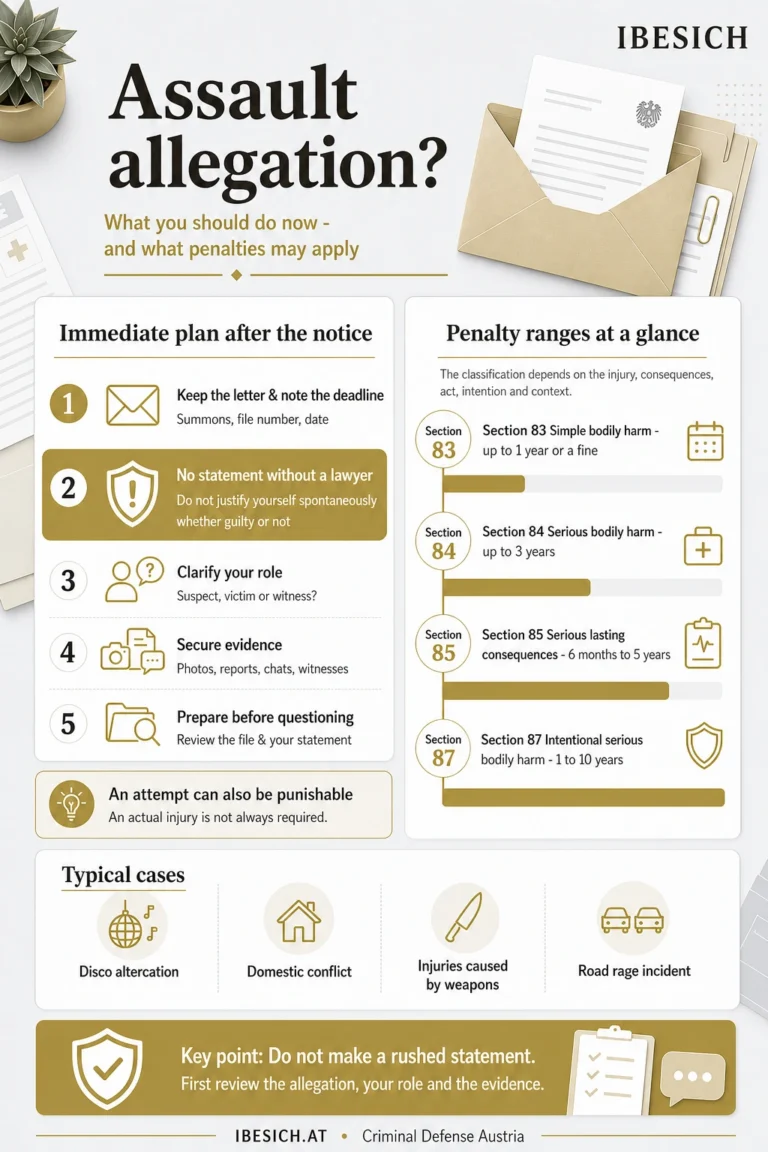
- Whether guilty or not: do not make a statement without first consulting a lawyer
Table of Context
Report for Assault: First Steps
After a report for assault, the first step should be to clarify whether you are affected as a suspect, witness or victim. This role determines which rights apply and how carefully you should handle your own statements.
Suspects do not have to explain the allegation in substance immediately. It usually makes sense to first review the summons, the state of the file and the specific suspicion.
In my work as a lawyer, I often see people react too quickly in the first days after an incident: they explain themselves spontaneously, delete messages or underestimate medical documentation. Precisely these early steps can later be decisive.
As a rule, no statement should be made before consulting a lawyer, regardless of whether guilt exists or not.
Evidence that may later be harder to secure is also important. This includes photos of injuries or damaged objects, medical documents, chat histories, names of witnesses and the most accurate possible timeline.
Victims should have injuries documented promptly. Even if an injury initially seems minor, the later legal classification may depend on how long pain, incapacity for work or health restrictions actually last.
What Counts as Assault in Austria?
Assault does not necessarily require a dramatic injury. An injury to the body or damage to health can already be sufficient.
Typical examples include bruises, cuts, swelling, pain after a blow, concussion or health consequences after being pushed. Psychological or physical impairments to health can also become relevant in individual cases if they can be sufficiently established under criminal law.
The Austrian Criminal Code distinguishes, among other things, between assault, serious assault, assault with serious permanent consequences and intentional serious assault. This distinction is important because it leads to very different sentencing ranges.
It is important to note that even an attempted assault can be prosecuted under criminal law.
What Penalties Can Assault Carry?
The sentence is not determined by the external events alone. A slap, punch, push or injury with an object can be assessed very differently under criminal law depending on the consequences and what can be proven against the accused person.
This overview provides a quick orientation. It does not replace an individual legal assessment, but it shows why the medical consequences and the mental element are so important.
| Classification | Typical core issue | Possible sentencing range | What often matters in practice |
|---|---|---|---|
| Simple assault | Injury or damage to health without serious qualification | up to 1 year imprisonment or a fine | injury pattern, evidence, intent, possible justification |
| Serious assault | e.g. damage to health lasting more than 24 days or an injury serious in itself | up to 3 years imprisonment | medical findings, duration of symptoms, type of injury |
| Assault with serious permanent consequences | permanent or particularly grave consequences | significantly increased sentencing range | long-term medical consequences, expert opinions, incapacity for work |
| Intentional serious assault | serious injury was intentionally inflicted | 1 to 10 years imprisonment; higher where serious consequences occur | proof of intent, sequence of events, direction of the attack |
Simple Assault
Simple assault concerns cases in which someone is injured on the body or harmed in their health. The sentencing range extends to up to one year of imprisonment or a fine.
A person who physically mistreats another person and thereby negligently injures them or harms their health can also fall within this category. In practice, this includes blows, pushes or physical attacks that do not result in serious injury.
Serious Assault
Serious assault is particularly relevant where damage to health or incapacity for work lasts longer than 24 days or where the injury is serious in itself. The sentencing range can extend to up to three years of imprisonment.
Case law shows how much depends on the specific injury: the Austrian Supreme Court has, for example, treated a nasal bone fracture with displacement of the fracture ends as an injury serious in itself (OGH 11 Os 67/84). At the same time, a broken nose is not automatically serious in every case; this distinction is also reflected in case law (RIS case law RS0092611).
Certain circumstances can also aggravate the assessment, for example if the offence is committed against certain protected professional groups or in a particularly dangerous manner.
Assault with Serious Permanent Consequences
The allegation becomes especially serious when permanent or long-lasting consequences occur. These include serious damage to sensory functions, conspicuous disfigurement, substantial mutilation, severe suffering or permanent incapacity for work.
The sentencing range is significantly higher in such cases. What matters is which medical consequences can be proven and whether they legally qualify as serious permanent consequences.
Intentional Serious Assault
Intentional serious assault does not arise from every serious injury. It must additionally be provable that the serious assault was inflicted intentionally.
This makes the mental element especially important: did the accused person specifically intend to cause a serious injury, or was an injury foreseeable but not intended? This distinction can be decisive for sentencing. The Austrian Supreme Court has stressed that intent under Section 87 StGB must relate to the result of a serious injury (OGH 13 Os 142/99).
Typical Cases from Practice
Assault often arises in situations that initially seem ordinary and then escalate. This is precisely why the later legal classification is often more complicated than it appears at first glance.
Practice in my law firm has shown that it is often not the loudest account that decides the case, but the cleanest reconstruction. Who stood where and when, who became physical first and which injury is actually documented often makes the difference.
| Practical case | Typical disputed question | Important evidence |
|---|---|---|
| Bar, club or disco | Who started it, who defended themselves, who caused which injury? | video, security staff, witnesses, medical findings |
| Domestic setting | One-off escalation, repeated violence, threat or mutual accusations? | photos, messages, medical documentation, risk reports |
| Workplace, school, neighbourhood | Physical attack or conflict situation not yet punishable? | witnesses, internal reports, chat histories, medical findings |
| Public space or traffic | Briefly escalated dispute, self-defence or targeted attack? | video, neutral witnesses, police documents |
Dispute in a Bar, Club or Disco
A classic case is a dispute in nightlife. Two people clash, there is pushing, someone strikes, a third person intervenes. Later it is often unclear who started it, who defended themselves and which injury resulted from which action.
Alcohol may explain an escalation, but it does not automatically remove the allegation. Witness statements, video footage, reports from security staff and medical documents are particularly important for the defence or victim representation.
Violence in the Domestic Sphere
Domestic violence often involves recurring conflicts, dependencies and one-person’s-word-against-another situations. Assault can overlap here with threats, coercion or stalking.
For victims, documentation, protective measures and the question of court support are important. For suspects, it is crucial to clearly distinguish the specific allegation from relationship conflict, mutual accusations and acts that are actually punishable.
Neighbourhood, Workplace or School
Physical attacks can also have criminal consequences in the workplace, at school or in neighbourhood disputes. A push in a stairwell, grabbing someone’s arm, a scuffle at work or an attack among young people can be examined as assault.
In such cases, further consequences often play a role alongside the criminal proceedings: employment-law steps, school measures, damages claims or contact bans.
Traffic and Public Space
In road traffic or public transport, physical attacks can arise from brief conflicts. Examples include a push on a platform, a blow after a traffic dispute or an attack against inspection staff.
In public spaces there are more often neutral witnesses or video recordings. These can be decisive because those involved often describe the sequence of events differently.
Assault with Objects or Weapons
If an object is used in an attack, the legal assessment can become significantly more serious. However, it does not depend only on whether the object would colloquially be called a weapon.
A glass bottle, bunch of keys, chair, tool, knife, heavy everyday object or vehicle can also be dangerous in the specific case. The decisive questions are how the object was used, what injuries occurred and whether danger to life, particular brutality or serious consequences were to be expected.
The same object can therefore be assessed differently in different cases. A bottle that falls to the ground in a scuffle is different from a bottle deliberately struck against someone’s head.
Details are therefore important for the criminal-law classification: distance, force, direction, affected body part, injury pattern, medical findings and witness statements.
Fights, Brawling and Several Participants
In fights involving several people, it is often difficult to establish who delivered which blow. But that does not mean participation has no criminal consequences.
The Austrian Criminal Code has a separate offence of brawling. Anyone who actively participates in a fight can already be punished for that participation if the fight causes serious bodily injury or the death of another person.
Participation in an attack by several people can also be punishable if it causes bodily injury, serious bodily injury or the death of another person.
In practice, it is therefore important to clarify one’s own role precisely:
- Did someone actively strike?
- Was someone only separating others or calming the situation?
- Did someone hold another person?
- Was someone encouraging the escalation?
- Did someone withdraw from the situation?
These differences can be substantial. Self-defence can also play a role, but it must be examined carefully. In a recent decision, the Austrian Supreme Court again addressed the relationship between brawling and self-defence (OGH 14 Os 33/24v).
Other Violent Offences
Violent offences are not limited to visible injuries. Threats, coercive situations and persistent pursuit can also be criminally relevant.
The following overview helps with a quick classification:
| Offence | Core issue | Typical digital or practical examples |
|---|---|---|
| Threat | Intimidation through a dangerous threat | messages, calls, personal threats, online threats |
| Coercion | Someone is to be forced into conduct by violence or threat | pressure in relationships, work, traffic or money conflicts |
| Stalking | Persistent pursuit with unreasonable interference in the way of life | repeated contact, lying in wait, messages, contact through third parties |
| Unsolicited intimate images | sexual boundary violation by unwanted sending or showing | unsolicited intimate image by WhatsApp, AirDrop, messenger or social media |
Threat
A dangerous threat means that someone is threatened in order to place them in fear and unrest. This can happen in person, by phone, by message or online.
Not every unfriendly statement is automatically punishable. A threat becomes relevant above all where, according to its content, the situation and the surrounding circumstances, it is capable of causing serious fear. The Austrian Supreme Court assesses the suitability of a threat according to an objective-individual standard: the specific situation and the person affected matter, not only the wording (OGH 9 Os 120/78).
Coercion
Coercion exists where someone is forced by violence or dangerous threat to act, tolerate something or refrain from acting. The issue is therefore not only the threat itself, but its purpose: a person is to be made to behave in a certain way.
Typical constellations include pressure situations in relationships, road traffic, the workplace or in connection with money, property or ending contact.
Stalking
Stalking is covered by law as persistent pursuit. It refers to repeated actions over a longer period that are capable of unreasonably interfering with a person’s way of life.
This may include repeatedly seeking proximity, constant contact, messages through various channels or actions through third parties. The persistence and the burden on the affected person are decisive.
Unsolicited Intimate Images
Sending an unsolicited intimate image can also be criminally relevant. Since the reform of Section 218 StGB, the law expressly covers harassment of another person through an unsolicited image of genitals, the pubic area or buttocks.
This does not fit every assault situation, but it does fit articles about violent offences in the broader sense. In practice, such messages often occur together with threats, stalking, relationship conflicts or digital intimidation. It is important to preserve screenshots, sender data, timestamps and the communication history.
Victims’ Rights and Claims After an Assault
Victims of a violent offence have their own rights in criminal proceedings. Depending on the situation, these include information, protection, access to files, representation, court support and the possibility of asserting claims as a private party.
In assault cases, the issues often include pain and suffering compensation, treatment costs, loss of earnings or other consequences. Participation as a private party can make it possible to assert such claims already in the criminal proceedings.
Particularly affected victims may be entitled to psychosocial or legal court support. This support is intended to help them understand the proceedings, exercise their rights and cope better with the burden.
Young People and Assault
Special rules and different educational objectives apply to young people compared with adults. Nevertheless, assault among young people can also have criminal consequences.
Relevant factors include age, maturity, contribution to the offence, prior convictions, consequences for the victim and whether the incident was a one-off escalation or repeated violence.
For parents, it is important to clarify early whether their child is being treated as a suspect, victim or witness. Especially in incidents at school, in groups or in public spaces, statements and chat histories can quickly become very important.
When Does a Criminal Defence Lawyer Make Sense?
A criminal defence lawyer is particularly useful if there is a report for assault, serious assault, brawling, threat, coercion or stalking and the police or public prosecutor’s office are already investigating.
This applies especially where there is a summons for questioning as a suspect, serious injuries are alleged, several participants have given statements, videos or chats exist, or civil-law claims are also threatened.
An early legal assessment helps you understand your own role, secure evidence and decide whether and when a statement is sensible.
Conclusion
Assault and violent crimes in Austria are distinguished according to severity, consequences and the context of the offence. For suspects and victims, it is therefore crucial not to downplay the specific allegation, but also not to classify it incorrectly too quickly.
Anyone affected should secure documents, document injuries, take deadlines and summonses seriously and clarify their own procedural role. If financial consequences arise alongside the criminal proceedings, questions of damages may also become relevant.
Frequently Asked Questions About Assault and Violent Crimes
What should you do if you are reported for assault?
First, it should be clarified whether you are being treated as a suspect, victim or witness. The summons, allegation, evidence and possible duties to give evidence should then be reviewed. A statement should never be made without a lawyer, regardless of whether you are guilty or not. This can have serious consequences later.
What is minor assault in Austria?
In everyday language, this usually means simple assault without serious consequences. Legally, the decisive question is whether someone was injured or harmed in their health and whether aggravating circumstances exist.
When is assault considered serious?
Serious assault is particularly relevant where damage to health or incapacity for work lasts longer than 24 days, where the injury is serious in itself, or where certain aggravating circumstances apply.
What penalty do first-time offenders face for assault?
That depends on the injury, the contribution to the offence, prior conduct, insight, compensation for damage and the procedural situation. Being a first-time offender alone does not guarantee any particular penalty.
Does alcohol matter in assault cases?
Alcohol can explain how events unfolded, but it does not automatically remove the criminal allegation. Depending on the case, intoxication can play a role in culpability, assessment of evidence or sentencing.
Can simply participating in a fight be punishable?
Yes. In cases of brawling, active participation can already be punishable if the fight causes serious consequences such as serious bodily injury or death.
Can a threat by SMS or WhatsApp be punishable?
Yes, if it legally qualifies as a dangerous threat. The content, context and suitability to cause fear and unrest are decisive.
What is the difference between a threat and coercion?
With a threat, intimidation is the main focus. With coercion, violence or a dangerous threat is used to force someone to act, tolerate something or refrain from doing something.
When does stalking become punishable?
Stalking becomes punishable when someone unlawfully and persistently pursues another person and that conduct is capable of unreasonably interfering with their way of life.
Is an unsolicited intimate image punishable in Austria?
Yes, it can be punishable. Section 218 of the Austrian Criminal Code also covers harassment through unsolicited images of genitals, the pubic area or buttocks.
What rights do victims have after an assault?
In criminal proceedings, victims may have rights to information, protection, representation, court support and participation as a private party to assert claims.
Sources
- Criminal Code: assault and violent crimes
- Threats, coercion, stalking and sexual harassment
- Selected case law
- OGH 11 Os 67/84: displaced nasal bone fracture as an injury serious in itself
- RIS case law RS0092611: a nasal bone fracture is not automatically a serious injury in every case
- OGH 13 Os 142/99: intent in intentional serious assault
- OGH 14 Os 33/24v: brawling and self-defence
- OGH 9 Os 120/78: dangerous threat assessed by an objective-individual standard
- Victims’ rights and court support
What Our Clients Say
Find more reviews on our Google Business Profile
Get in Touch
You can reach us by phone, email, or via our contact form.
IBESICH
Josefstädter Straße 11/1/16
1080 Wien
MO-FR: 9 am to 6 pm
You are currently viewing a placeholder content from Google Maps. To access the actual content, click the button below. Please note that doing so will share data with third-party providers.
More Information
You need to load content from reCAPTCHA to submit the form. Please note that doing so will share data with third-party providers.
More InformationInsights from the IBESICH law firm
News from the firm and legal updates in Austria.